

Infant Biometrics Market Surges in 2026 with Fingerprint Technology Dominating 100% Share
The infant biometrics market report by Towards Healthcare, a sister firm of Precedence Research, offers a data-driven outlook on the rapidly evolving landscape of digital identification for newborns. This brief explores how advancing technologies and growing global adoption are shaping secure, accurate, and scalable infant identity solutions.
Ottawa, Dec. 02, 2025 (GLOBE NEWSWIRE) -- The global infant biometrics market is on an upward trajectory, poised to generate substantial revenue growth, potentially climbing into the hundreds of millions over the forecast years from 2025 to 2034. This market is rising because healthcare systems, governments, and NGOs increasingly recognize the need for precise and secure identity registration from birth to improve child health outcomes, security, and civil registration systems.
The Complete Study is Now Available for Immediate Access | Download the Sample Pages of this Report @ https://www.towardshealthcare.com/download-sample/5811
Key Takeaways:
- North America dominated the global infant biometric market in 2024.
- Asia Pacific is expected to grow significantly during the forecast period.
- By technology type, the fingerprint recognition segment dominated the market with 100% in 2024.
- By technology type, the iris recognition segment is expected to be the fastest growing during the forecast period.
- By component type, the biometric scanners segment dominated the market with 70% in 2024.
- By component type, the infant-specific biometric algorithms segment is expected to be the fastest growing during the forecast period.
- By application type, the newborn identification in hospitals segment dominated the market with 50% in 2024.
- By end user, the hospitals and neonatal care units segment dominated the global infant biometric market with 100% in 2024.
Market Overview:
Infant biometrics is defined as the use of physiological characteristics, e.g., fingerprints, iris, footprints, or handprints, to identify a newborn and infant as a unique subject. The last few years has seen increased momentum towards infant biometrics as hospitals, birth registrars, and vaccination programs come to expect reliable and technologically-enabled tiers of identity from birth.
The market, moreover, is expanding with improved resolution in sensors, algorithmic matching, and non-contact capture that surpass inherent barriers of infant biology. Partnership with public health agencies, and alignment with global identity markers, is also impacting value generation. Therefore, the infant biometrics industry is becoming a minor niche tailored away from the larger healthcare biometrics sector, that is expected to see durable expansion and more innovation.
You can place an order or ask any questions, please feel free to contact us at sales@towardshealthcare.com
Major Growth Drivers:
What are the major growth drivers for infant biometrics?
- Legal identity from day of birth & Protection of birth registration: Most countries do not have a consistent or functional birth registration. Infant biometric solutions establish the legal identity of each child immediately and support social welfare, public health monitoring, and achievement of SDG goals in our society.
- Minimizing misidentifications of newborns, baby swaps, and child trafficking: Hospitals and government are making investments in biometric measures to reduce and eliminate baby swaps, misidentification of newborns, and trafficking of newborns. These measures include utilizing unique biometrics for identification and preventing child trafficking.
- Technology advances in sensor design and capture algorithms: Advances in technology such as ultra-high-resolution imaging, warp compensation during capture, and designs of platens that are newborn friendly allow us to record fingerprint and iris captures with much more reliability.
- Desire for immunization tracking application & health systems clearinghouse functions: Public health systems and governmental health support systems are adopting biometric systems to track newborn and childhood immunization schedules to reduce medical errors as well as maintaining health records for children from one health system to another.
-
Support internationally and partnerships from governments, NGOs & initiatives: Internationally sponsored development programs, NGOs, and countries' national identity systems are partnering to deploy infant biometric systems in under-resourced populations to grant access to health care and effective civil registration.
Key Drifts:
What does the current landscape look like for infant biometrics moving ahead?
- The best future infant imaging systems will rely on non-contact or free-space imaging techniques to help mitigate distortion and improve usability and workflow in newborn units.
- There is also good feedback for new algorithms utilizing deep learning as well as growth-aware algorithms which can model biometric change as infants develop while keeping matching at high accuracy levels over time.
- Iris recognition in infants is emerging as a valid alternative and shows promising results as early as four to six weeks of age. Tests so far have indicated strong potential for accuracy.
- Databases containing longitudinal biometric trait data (e.g. neonatal fingerprint datasets) are being developed in order to train biometric models and validate performance.
You can place an order or ask any questions, please feel free to contact us at sales@towardshealthcare.com
Significant Challenge:
Challenge: Variability in physiology and limited data
The greatest challenge in the infant biometrics industry is still high physiological variability in infants, changes in finger size, skin elasticity, ridge quality, and artifact due to growth, all of which make accurate capture and matching difficult. In addition, there is not a substantial amount of large and diverse longitudinal datasets available for training and validating algorithms. Algorithms need sufficient data for infants' growth trajectories, and many algorithms will not generalize well without enough data, which can lead to false rejections or acceptances.
Regional Analysis:
The infant biometrics sector is presently led by North America. The region is already equipped with an intricate healthcare infrastructure, significant investment in digital health, and governmental support for systems of identity and security. Several hospitals and neonatal units in the US and Canada are that are leading the way in implementing cutting-edge biometrics and linking it with their electronic health record systems. Furthermore, the regulatory framework and privacy standards in North America can provide a strong justification for the implementation of sensitive biometric technologies. The positioning of several major biometric firms and early adopters of technology in North America further solidifies is an absolutely appropriate regional marking point.
Asia-Pacific is emerging as the fastest growing region for infant biometrics market thanks to high volume birth populations, rapid digitization of healthcare facilities, and mounting pressure on public health systems. Countries like India, China, and Southeast Asia are enthusiastic about the relevance of infant biometrics to help close gaps on identity and tracking immunizations as part of a broader national agenda. Pilot biometric programs for birth registration already exist in Asia-Pacific. Additionally, per capita healthcare expenditures and technology availability and adoption are rapidly increasing making Asia-Pacific a region of potential growth. The urgency to solve child welfare and birth registration deficits in rural and marginalized groups adds to accelerate uptake.
Get the latest insights on life science industry segmentation with our Annual Membership: https://www.towardshealthcare.com/get-an-annual-membership
Segmental Insights:
By technology type:
Fingerprint recognition continued its stronghold on the infant biometrics market through 2024 due to its maturity, ease of capture compared to other modalities, and existing algorithmic support. Historically, fingerprinting has made it easier to persist and enter the market for new biometric identifications in deployment sites in hospitals and identification programs.
Iris recognition in infants is anticipated to be the fastest-growing biometric during the projection period because researchers are developing specialized sensors and segmentation algorithms suited to small infant iris patterns. Studies in the past three years have explored the ability to capture infant iris features at 4–6 weeks old, indicating that folds may provide a viable option for a non-contact biometric identification that has stability over time.
By component:
The biometric scanners component, hardwrae was the dominant category in 2024 at an approximately 70% share because the primary hardship relates to the difficult task of physically obtaining the infant's delicate biometric characteristics. Several deployments focus on the initial step of acquiring a specific hardware infant-friendly scanner.
Infant biometric algorithms are anticipated to have the highest growth during the forecast period due to software providers investing to build out distortion correction, growth modeling, and improved matching algorithms for infants. These software pipelines will benefit from improved performance even where someone is using a simpler or lower cost capture device.
By application type:
Newborn identification in hospitals led the application section in 2024, with a share of 50%, because most current implementations are targeted to hospital environments to ensure the assignment of identity immediately after birth, and incompatibility, swaps, or loss of infants while in a neonatal unit.
By end user:
Hospitals and neonatal care units represented the leading end user of infant biometric solutions, with a practice share of 100%, because infant biometric solutions are deployed primarily in clinical contexts where a birth and an initial identity capture occur immediately postpartum.
Recent Developments:
On June 13, 2025, Integrated Biometrics unveiled InfantID, a novel fingerprinting solution optimized for newborn capture, aiming to support birth-based identity systems globally. The system uses compact platen design and distortion-aware algorithms to improve image quality.
Browse More Insights of Towards Healthcare:
The global brain computer interface market size is expected to increase from USD 3.21 billion in 2025 to USD 12.87 billion by 2034, growing at a CAGR of 16.7% throughout the forecast period from 2025 to 2034.
The global intraoperative radiation therapy market size is calculated at USD 69.6 million in 2025, grew to USD 74.09 million in 2026, and is projected to reach around USD 130.18 million by 2035. The market is expected to expand at a CAGR of 6.45% from 2026 to 2035.
The protein chip market size marked US$ 2.36 billion in 2025 and is forecast to experience consistent growth, reaching US$ 2.54 billion in 2026 and US$ 4.98 billion by 2035 at a CAGR of 7.78%.
The insulin pens market size was valued at US$ 51.01 billion in 2025 and is projected to grow to 55.02 billion in 2026. Forecasts suggest it will reach approximately US$ 100.79 billion by 2034, registering a CAGR of 7.86% during the period.
The global artificial intelligence in magnetic imaging (MRI) market is forecasted to expand from USD 6.13 billion in 2024 to USD 11.22 billion by 2034, growing at a CAGR of 6.23% from 2025 to 2034.
The insulin pump market is forecast to grow at a CAGR of 9.65%, from USD 6.87 billion in 2024 to USD 17.25 billion by 2034, over the forecast period from 2025 to 2034.
The global single-use bioprocessing market is expected to increase from USD 30.77 billion in 2025 to USD 112.2 billion by 2034, growing at a CAGR of 15.46% throughout the forecast period from 2025 to 2034.
The global non-invasive aesthetic treatments market size is forecast to grow from USD 83.13 billion in 2025 to USD 238.04 billion by 2034, driven by a CAGR of 12.4% from 2025 to 2034.
The global 3D printed prosthetics market size is calculated at USD 1.79 billion in 2024 and is expected to be worth USD 3.84 billion by 2034, expanding at a CAGR of 7.9% from 2024 to 2034, as a result of advanced benefits over traditional prosthetics.
The global non-invasive blood glucose monitoring system market size is calculated at USD 34 million in 2024 and is expected to be worth USD 316.65 million by 2034, expanding at a CAGR of 25% from 2024 to 2034.
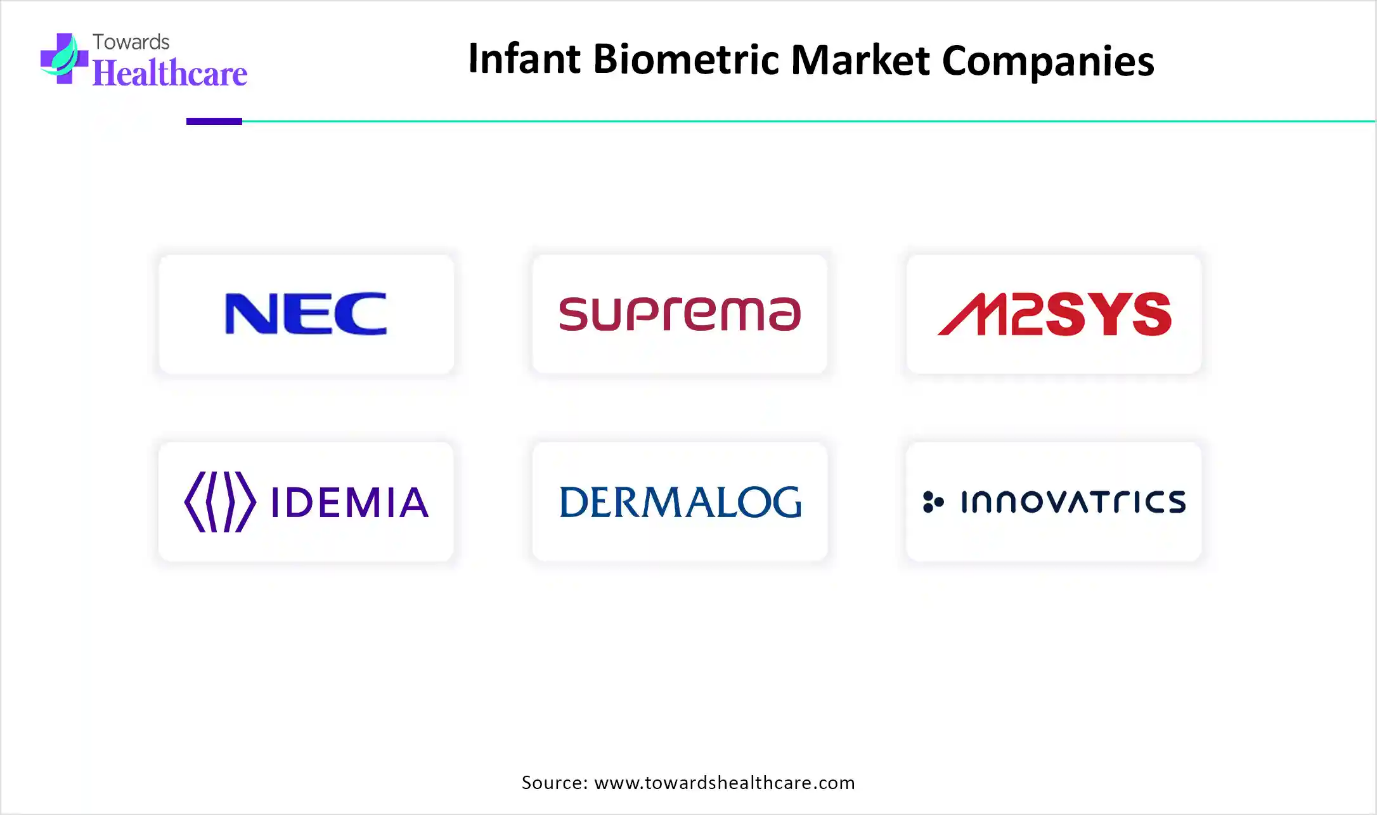
Infant Biometric Market Key Players List:
- NEC Corporation
- Aadhar/NPCI (India – Government initiative using infant biometrics)
- Suprema Inc.
- M2SYS Technology
- IDEMIA
- Dermalog Identification Systems
- NEC Newborn Identification Research (NEC Labs)
- Innovatrics
- HID Global
- Aware Inc.
- ZKTeco
- Fujitsu
- Thales Group
- Tech5
- BixeLab
- Mofiria Corporation
- Trueface.ai
- BioRugged
- Imprivata
- Bion Biometrics
Segments Covered in the Report
By Technology
- Fingerprint Recognition (Dominant) 100%
- Palmprint Recognition
- Iris Recognition (Fastest Growing)
- Ear Shape Recognition
- Multimodal Biometrics (Fingerprint with Voice Recognition)
- Others
By Component (Fingerprint Recognition)
- Biometric Scanners (Dominant) 70%
- Biometric Data Processing Software
- Infant-specific Biometric Algorithms (Fastest Growing)
- System Integration
- Support & Maintenance
By Application
- Newborn Identification in Hospitals (Dominant) 50%
- Immunization and Health Record Tracking
- National ID Enrollment / Civil Registration
- Preventing Infant Swapping or Misidentification
- Others (Fastest Growing)
By End User
- Hospitals and Neonatal Care Units (Dominant) 100%
- NGOs and International Organizations
- Research Institutes & Academia
- Others (Fastest Growing)
By Region
- North America
- U.S.
- Canada
- Asia Pacific
- China
- Japan
- India
- South Korea
- Thailand
- Europe
- Germany
- UK
- France
- Italy
- Spain
- Sweden
- Denmark
- Norway
- Latin America
- Brazil
- Mexico
- Argentina
- Middle East and Africa (MEA)
- South Africa
- UAE
- Saudi Arabia
- Kuwait
Immediate Delivery Available | Buy This Premium Research @ https://www.towardshealthcare.com/checkout/5811
Access our exclusive, data-rich dashboard dedicated to the healthcare market - built specifically for decision-makers, strategists, and industry leaders. The dashboard features comprehensive statistical data, segment-wise market breakdowns, regional performance shares, detailed company profiles, annual updates, and much more. From market sizing to competitive intelligence, this powerful tool is one-stop solution to your gateway.
Access the Dashboard: https://www.towardshealthcare.com/access-dashboard
About Us
Towards Healthcare is a leading global provider of technological solutions, clinical research services, and advanced analytics, with a strong emphasis on life science research. Dedicated to advancing innovation in the life sciences sector, we build strategic partnerships that generate actionable insights and transformative breakthroughs. As a global strategy consulting firm, we empower life science leaders to gain a competitive edge, drive research excellence, and accelerate sustainable growth.
You can place an order or ask any questions, please feel free to contact us at sales@towardshealthcare.com
Europe Region: +44 778 256 0738
North America Region: +1 8044 4193 44
APAC Region: +91 9356 9282 04
Web: https://www.towardshealthcare.com
Our Trusted Data Partners
Precedence Research | Statifacts | Towards Packaging | Towards Automotive | Towards Food and Beverages | Towards Chemical and Materials | Towards Consumer Goods | Towards Dental | Towards EV Solutions | Nova One Advisor | Healthcare Webwire | Packaging Webwire | Automotive Webwire | Nutraceuticals Func Foods | Onco Quant | Sustainability Quant | Specialty Chemicals Analytics
Find us on social platforms: LinkedIn | Twitter | Instagram | Medium | Pinterest


Legal Disclaimer:
EIN Presswire provides this news content "as is" without warranty of any kind. We do not accept any responsibility or liability for the accuracy, content, images, videos, licenses, completeness, legality, or reliability of the information contained in this article. If you have any complaints or copyright issues related to this article, kindly contact the author above.
